New Delimitation Bill 2026 PDF Download
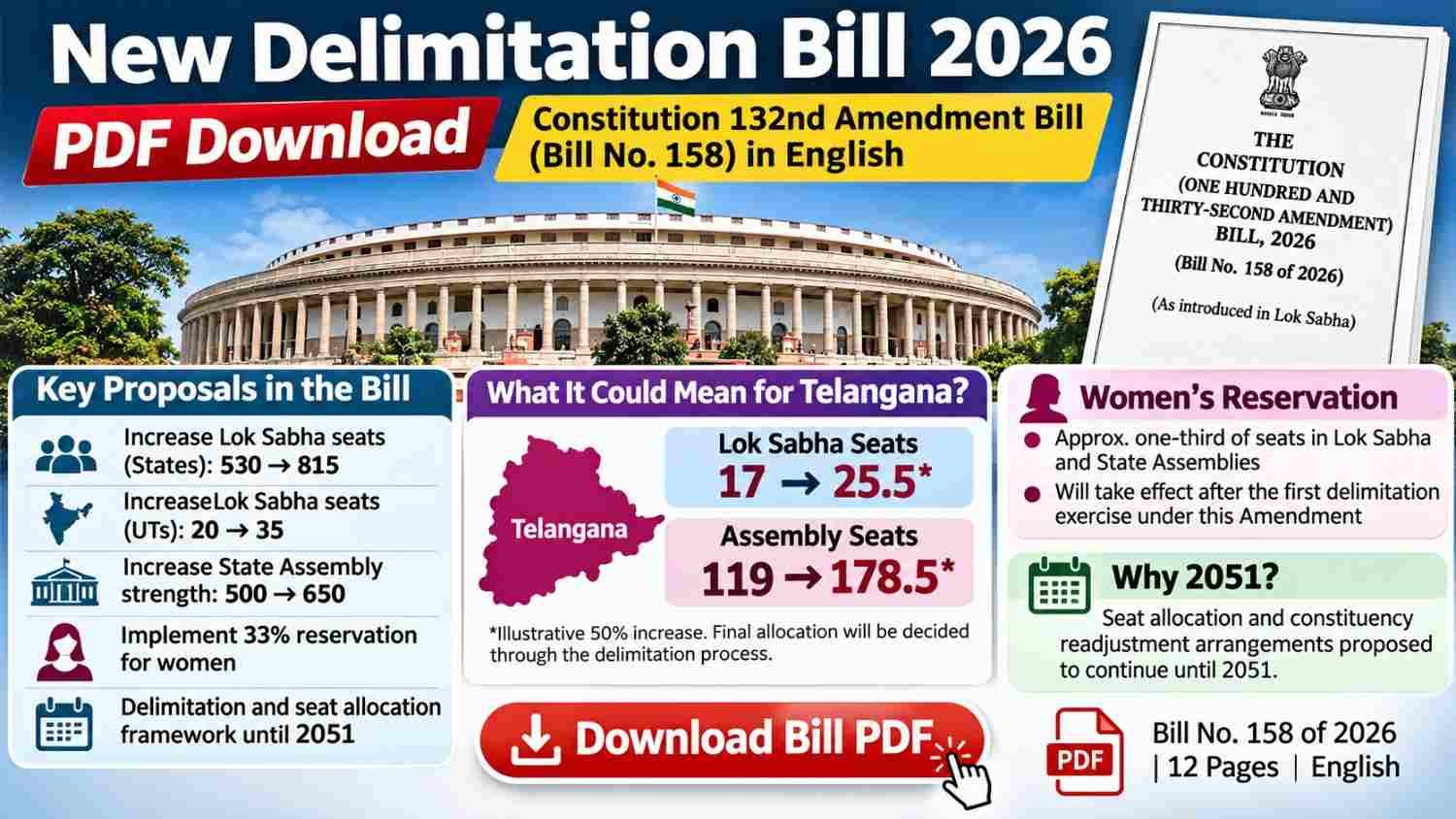
The Constitution (One Hundred and Thirty-Second Amendment) Bill, 2026, has been prepared for introduction in the Lok Sabha on November 27, 2026. The proposed constitutional amendment focuses on delimitation, increasing the strength of the Lok Sabha and State Legislative Assemblies, and implementing 33% reservation for women in elected legislatures.
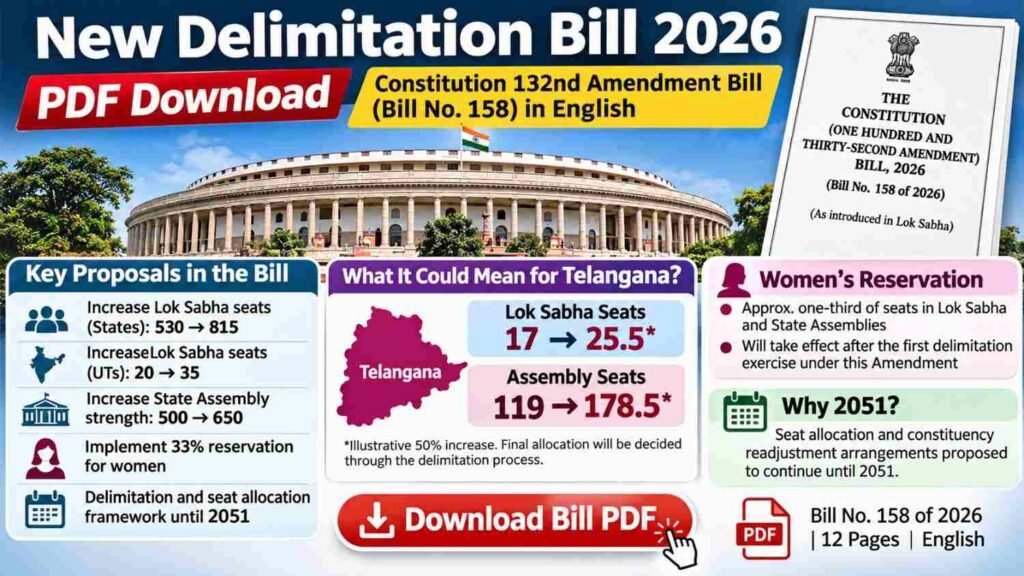
The Bill is listed as Bill No. 158 of 2026 and is available in English. Candidates preparing for competitive examinations, students and people interested in Indian politics can download the original Bill PDF below.
Constitution 132nd Amendment Bill 2026 PDF Download
Document details:
| Particulars | Details |
|---|---|
| Bill Name | Constitution (One Hundred and Thirty-Second Amendment) Bill, 2026 |
| Bill Number | 158 of 2026 |
| Introduced by | Arjun Ram Meghwal |
| Ministry | Ministry of Law and Justice |
| Date | November 27, 2026 |
| Language | English |
| Total Pages | 12 |
| Document Format |
Download the original Bill in English:
Download Constitution 132nd Amendment Bill 2026 PDF
Note: This is the Constitution Amendment Bill. The separate Delimitation (Second) Bill, 2026, is another document in the same legislative package.
What is the Constitution 132nd Amendment Bill 2026?
The Constitution (132nd Amendment) Bill, 2026, proposes changes to several provisions of the Indian Constitution to facilitate delimitation and bring women’s reservation in Parliament and State Legislative Assemblies into effect.
The Bill seeks to revise the existing constitutional framework governing the allocation of seats, constituency readjustment and the implementation of women’s reservation.
One of its major proposals is to increase the number of seats in the Lok Sabha and State Legislative Assemblies by 50% through the proposed delimitation exercise.
The Bill also proposes to extend the existing census-related restrictions on seat readjustment until 2051.
Key Highlights of the 132nd Constitutional Amendment Bill
The major proposals included in the Bill are:
- Increase the maximum number of Lok Sabha members elected from States from 530 to 815.
- Increase the maximum number of Lok Sabha members representing Union Territories from 20 to 35.
- Increase the maximum strength of State Legislative Assemblies from 500 to 650 members.
- Provide for a 50% increase in the number of seats allocated to each State and Union Territory during the proposed delimitation exercise.
- Bring women’s reservation into effect after the first delimitation exercise undertaken following commencement of the proposed Amendment.
- Continue the relevant seat-allocation and constituency readjustment arrangements until 2051.
- Include Jammu and Kashmir in the definition of State for the purposes of Articles 54 and 55 relating to the election of the President.
Proposed Increase in Lok Sabha and Assembly Seats
One of the important proposals is the expansion of the maximum permissible strength of the Lok Sabha and State Legislative Assemblies.
The Bill proposes the following changes:
| House | Existing maximum | Proposed maximum |
|---|---|---|
| Lok Sabha – States | 530 | 815 |
| Lok Sabha – Union Territories | 20 | 35 |
| State Legislative Assemblies | 500 | 650 |
These figures represent proposed constitutional maximums. They do not mean that every State will automatically receive the maximum number of seats.
The actual allocation will depend on the delimitation framework and the implementation of the proposed provisions.
What Could Be the Impact on Telangana?
Telangana currently has 17 Lok Sabha constituencies and 119 Assembly constituencies.
The proposed Bill provides for a 50% increase in the number of seats allocated to each State and Union Territory during delimitation.
If the increase is calculated directly on the existing Telangana seat strength, the mathematical illustration would be:
| Representation | Existing seats | 50% increase illustration |
|---|---|---|
| Lok Sabha | 17 | 25.5 |
| Telangana Assembly | 119 | 178.5 |
These are illustrative calculations, not officially announced seat allocations. The Bill does not specify the final number of Lok Sabha or Assembly constituencies for Telangana.
If implemented, the proposed expansion could lead to more constituencies, changes in existing constituency boundaries and a new distribution of electoral representation across the State.
Women’s Reservation Under the Proposed Amendment
The Constitution (106th Amendment) Act, 2023, popularly known as the Nari Shakti Vandan Adhiniyam, introduced provisions for approximately one-third reservation for women in the Lok Sabha and State Legislative Assemblies.
However, its implementation was linked to a delimitation exercise following the publication of relevant Census figures.
The 132nd Amendment Bill proposes a revised mechanism.
Under the proposed replacement of Article 334A:
- Women’s reservation will take effect after the first delimitation exercise undertaken following commencement of the proposed Amendment.
- The delimitation exercise will provide for a 50% increase in seats allocated to each State and Union Territory in the Lok Sabha.
- The total number of seats in each State and Union Territory Legislative Assembly will also increase by 50%.
- Reserved seats for women will be allotted by rotation in a manner determined under legislation made by Parliament.
The proposed reservation is approximately one-third of the seats, not 50%. The proposed 50% increase relates to the total number of seats.
Why Is 2051 Important in the New Amendment?
The Bill proposes to replace references to the first Census taken after 2026 with the year 2051 in several constitutional provisions.
This is intended to provide a longer period of stability in the allocation of seats among States and the readjustment of constituencies.
The proposed changes affect Articles 55, 81, 82, 170, 330 and 332, among others.
The Bill also proposes changes to provisions concerning the reservation of seats for Scheduled Castes and Scheduled Tribes in Parliament and State Legislative Assemblies.
Important Articles of the Constitution Proposed to Be Amended
The Constitution 132nd Amendment Bill proposes changes to the following Articles:
| Article | Subject |
|---|---|
| Article 54 | Election of the President |
| Article 55 | Manner of election of the President |
| Article 81 | Composition of the Lok Sabha |
| Article 82 | Readjustment after each Census |
| Article 170 | Composition of State Legislative Assemblies |
| Article 330 | Reservation of seats for SCs and STs in Lok Sabha |
| Article 332 | Reservation of seats for SCs and STs in State Assemblies |
| Article 334A | Reservation of seats for women |
Difference Between the 132nd Amendment Bill and Delimitation (Second) Bill
The Constitution (132nd Amendment) Bill, 2026, and the Delimitation (Second) Bill, 2026, are separate legislative documents.
The Constitution Amendment Bill proposes changes to the Constitution, including the provisions governing seat expansion and women’s reservation.
The Delimitation (Second) Bill deals with the legal framework for conducting the delimitation exercise, including the role and responsibilities of the Delimitation Commission.
People looking for the complete delimitation legislation should therefore check both documents rather than treating them as the same Bill.
Current Status of the Constitution 132nd Amendment Bill 2026
The uploaded document is marked “To Be Introduced in Lok Sabha” and is dated November 27, 2026.
It is a proposed constitutional amendment, not an enacted law.
For a Constitution Amendment Bill to become law, it must:
- Be passed by each House of Parliament with the required special majority.
- Receive ratification from at least half of the State Legislatures because the proposed amendments affect provisions requiring state ratification.
- Receive the President’s assent.
The proposed provisions will come into force on a date appointed by the Central Government through notification in the Official Gazette.
Readers should check the latest parliamentary proceedings for subsequent developments.
Frequently Asked Questions
1. What is the Constitution 132nd Amendment Bill 2026?
It is a proposed constitutional amendment seeking changes to provisions concerning delimitation, the strength of Parliament and State Legislative Assemblies, and the implementation of women’s reservation.
2. What is the Bill number of the Constitution 132nd Amendment Bill?
The Bill is listed as Bill No. 158 of 2026.
3. Where can I download the 132nd Amendment Bill PDF?
You can download the original Constitution (132nd Amendment) Bill, 2026, in English using the PDF download link provided in this article.
4. Will Telangana Assembly seats increase under the proposed Bill?
The Bill proposes a 50% increase in the total number of seats in each State Legislative Assembly during the delimitation exercise. Telangana currently has 119 Assembly constituencies. However, its final proposed seat allocation has not been specified in this Bill.
5. Does the Bill provide 50% reservation for women?
No. The proposed women’s reservation is approximately one-third of the seats. The 50% increase refers to the expansion of the total number of seats.
6. Has the Constitution 132nd Amendment Bill become law?
The uploaded document is a Bill proposed for introduction in the Lok Sabha. It must complete the constitutional amendment process before becoming law.
Important Links
| Particulars | Link |
|---|---|
| Constitution 132nd Amendment Bill 2026 PDF | Download PDF |
| Official Parliament Website | Visit Website |
| Delimitation (Second) Bill 2026 | View Bill |
ALSO READ
- Telangana High Court Office Subordinate Certificate Verification Schedule 2026
- NIMS Hyderabad Senior Resident Recruitment 2026: 10 Departments, Application Form Download