About Telangana
Telangana is the youngest state in southern India, officially formed on 2 June 2014 after being separated from the former state of Andhra Pradesh. Hyderabad serves as the capital city and is one of India’s leading centers for information technology, biotechnology, education, healthcare, and commerce.
Known for its rich cultural heritage, historical monuments, vibrant festivals, and rapid economic growth, Telangana has emerged as one of India’s fastest-growing states. The state is home to ancient temples, majestic forts, beautiful lakes, wildlife sanctuaries, and world-renowned landmarks such as the Charminar, Golconda Fort, and the UNESCO World Heritage Site of Ramappa Temple.
NaTelangana provides comprehensive information about every district, mandal, village, government scheme, public service, and the latest developments across Telangana.
Telangana at a Glance
| Information | Details |
|---|---|
| State | Telangana |
| Formation Day | 2 June 2014 |
| Capital | Hyderabad |
| Largest City | Hyderabad |
| Official Language | Telugu |
| Additional Official Language | Urdu |
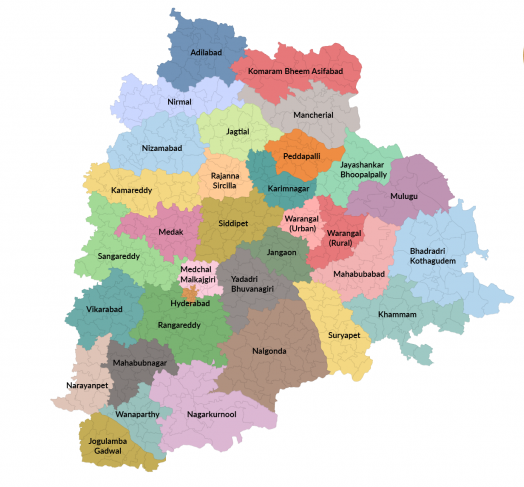
| Number of Districts | 33 |
| Number of Revenue Mandals | 621 |
| Number of Villages | 12769 |
| Legislative Assembly Seats | 119 |
| Lok Sabha Seats | 17 |
| Rajya Sabha Seats | 7 |
| High Court | High Court for the State of Telangana |
| Time Zone | Indian Standard Time (IST) |
History of Telangana
The history of Telangana dates back more than two thousand years and has been shaped by several powerful dynasties, including the Satavahanas, Kakatiyas, Bahmani Sultanate, Qutb Shahis, and the Asaf Jahi Nizams.
The Kakatiya dynasty played a significant role in developing irrigation tanks, temples, and forts throughout the region. The Thousand Pillar Temple and Ramappa Temple remain remarkable examples of Kakatiya architecture.
Following Indian independence in 1947, the Hyderabad State was integrated into the Indian Union in 1948 through Operation Polo. In 1956, Telangana became part of Andhra Pradesh under the States Reorganisation Act.
After decades of public movements demanding a separate state, Telangana officially became the 29th state of India on 2 June 2014.
Geography
Telangana is located on the Deccan Plateau in south-central India. The state shares its borders with Maharashtra, Chhattisgarh, Karnataka, and Andhra Pradesh.
The Godavari and Krishna rivers are the two major river systems supporting agriculture, drinking water supply, and irrigation across the state.
The climate is generally tropical with hot summers, moderate monsoons, and mild winters.
Administrative Divisions
For efficient governance, Telangana is divided into several administrative units.
- 33 Districts
- 589+ Revenue Mandals
- Thousands of Revenue Villages
- Municipal Corporations
- Municipalities
- Nagar Panchayats
- Gram Panchayats
Each district consists of multiple mandals, while each mandal contains several villages.
You can explore detailed information about:
- Telangana Districts
- Telangana Mandals
- Telangana Villages
- Assembly Constituencies
- Parliamentary Constituencies
- PIN Codes
through NaTelangana.
Districts of Telangana
Telangana consists of 33 districts, each with its own administrative headquarters, demographic profile, and cultural significance.
Some of the major districts include:
- Hyderabad
- Rangareddy
- Medchal–Malkajgiri
- Warangal
- Hanamkonda
- Karimnagar
- Nizamabad
- Khammam
- Mahabubnagar
- Nalgonda
- Adilabad
- Siddipet
- Sangareddy
- Mahabubabad
Every district page on NaTelangana provides detailed information including population, mandals, villages, schools, hospitals, transport facilities, elected representatives, and government statistics.
Population
According to the Census of India, Telangana has a population of more than 3.5 crore people, with a diverse mix of urban and rural communities.
The state has experienced significant urbanization, particularly around Hyderabad and its surrounding districts, while agriculture remains the primary occupation in many rural areas.
Population information on NaTelangana includes:
- Total Population
- Male Population
- Female Population
- Households
- Literacy
- Scheduled Castes (SC)
- Scheduled Tribes (ST)
Economy
Telangana has one of India’s fastest-growing economies.
Major sectors include:
- Information Technology (IT)
- Pharmaceuticals
- Biotechnology
- Agriculture
- Irrigation
- Manufacturing
- Textiles
- Mining
- Tourism
Hyderabad serves as a global technology hub, hosting offices of many national and international companies.
Agriculture
Agriculture remains a vital sector of Telangana’s economy.
Major crops include:
- Paddy
- Cotton
- Maize
- Red Gram
- Turmeric
- Chilli
- Soybean
Large irrigation projects such as the Kaleshwaram Lift Irrigation Project have significantly expanded irrigation coverage across many districts.
Education
Telangana has a well-developed education system comprising government schools, private schools, colleges, universities, engineering institutions, and research organizations.
The state is home to renowned institutions including:
- Osmania University
- University of Hyderabad
- Kakatiya University
- NALSAR University of Law
- IIT Hyderabad
- IIIT Hyderabad
Tourism
Telangana offers a wide range of tourist attractions, including:
- Charminar
- Golconda Fort
- Ramappa Temple (UNESCO World Heritage Site)
- Thousand Pillar Temple
- Yadadri Temple
- Basara Saraswati Temple
- Nagarjuna Sagar
- Medak Cathedral
- Bhongir Fort
- Laknavaram Lake
Tourism contributes significantly to the state’s economy and showcases Telangana’s rich historical and cultural heritage.
Culture and Festivals
Telangana is known for its vibrant traditions, folk arts, music, and festivals.
Popular festivals include:
- Bathukamma
- Bonalu
- Sammakka Saralamma Jatara
- Dasara
- Diwali
- Sankranti
- Ramzan
- Christmas
Traditional dance forms, handicrafts, handloom weaving, and local cuisine reflect the state’s diverse cultural identity.
Government and Administration
The Government of Telangana functions through various departments responsible for governance, education, health, agriculture, infrastructure, rural development, and public welfare.
The Legislative Assembly consists of 119 Assembly Constituencies, while the state elects 17 Members of Parliament to the Lok Sabha.
Why NaTelangana?
NaTelangana is dedicated to providing accurate, organized, and easy-to-access information about Telangana.
Our portal covers:
- Districts
- Mandals
- Villages
- Population Statistics
- Government Schemes
- Jobs & Recruitment
- Election Information
- Schools
- Hospitals
- Railway Stations
- Post Offices
- Public Services
- Latest Telangana News
Our goal is to make Telangana-related information accessible through a single, comprehensive platform.
Frequently Asked Questions
When was Telangana formed?
Telangana was officially formed on 2 June 2014 as the 29th state of India.
What is the capital of Telangana?
Hyderabad is the capital of Telangana.
How many districts are there in Telangana?
Telangana currently has 33 districts.
Which is the largest city in Telangana?
Hyderabad is the largest city and the capital of Telangana.
What is the official language of Telangana?
Telugu is the primary official language, and Urdu is also recognized as an additional official language.
What are the major rivers of Telangana?
The Godavari and Krishna rivers are the two major river systems flowing through Telangana.